
Pulse Armaments C1 — The Timed Blank-Firing Grenade I Found in the UK
I found the Pulse Armaments C1 at the National Airsoft Festival in the UK — a blank-firing grenade that runs on a two-second timer instead of an impact fuse. How it works, what it costs, and why the timer changes CQB entries.
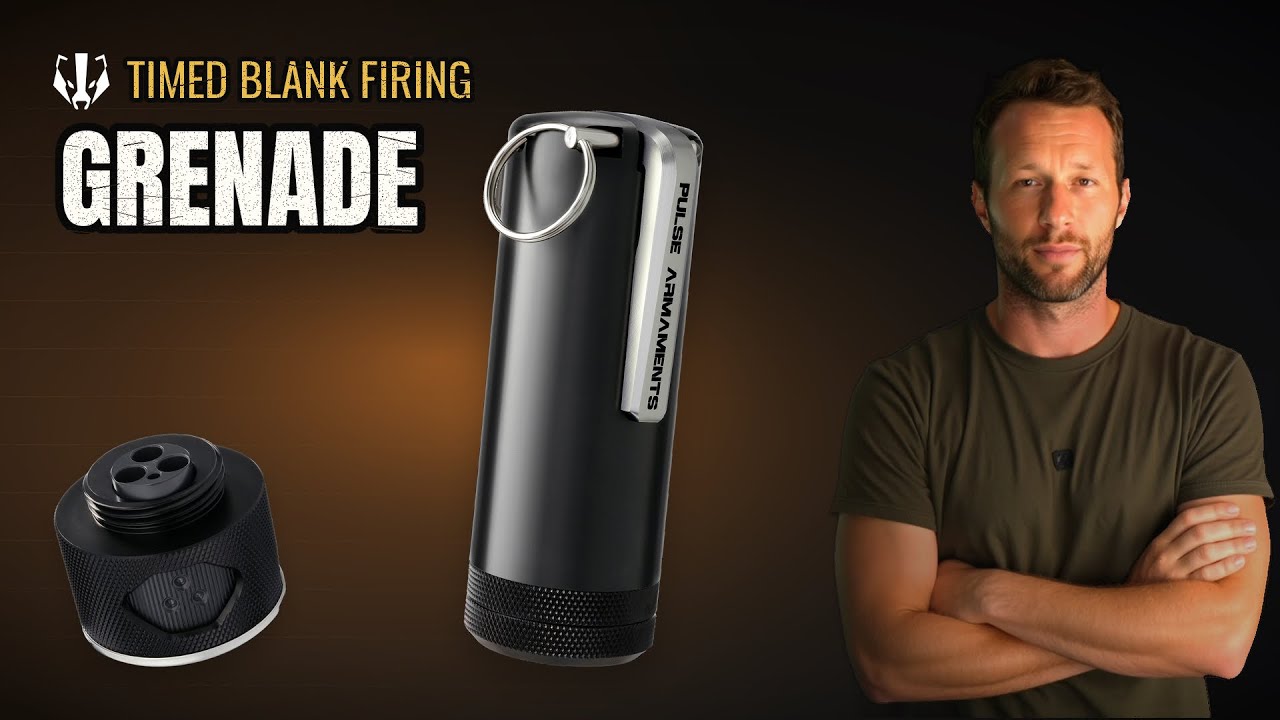
Pulse Armaments C1 — The Timed Blank-Firing Grenade I Found in the UK
This post covers airsoft equipment for recreational sporting use only.
The companion video — I Found This Airsoft Grenade In The UK — It’s A Game Changer — is the full walkthrough and demo. This post is the written version, with the detail that matters if you are deciding whether to buy one.
Disclosure up front: I bought the C1 with my own money at the Pulse Armaments stand at the National Airsoft Festival, with a small event discount. Nobody sent it to me for review, and nobody paid for this coverage.
How this landed on my radar
I had just spent almost two weeks in the UK — family stuff, then four airsoft events in five days across three CQB fields and an outdoor site. My body is covered in bruises, including one on my nose from a hit at Blackstone CQB. The last stop before flying back to LA was the National Airsoft Festival (NAF), and that is where this found me.
I was chatting with the guys at Tacteg — who have their own new product coming soon — and they walked me over to meet the founder of Pulse Armaments, a small UK company where he builds the products himself. I saw the C1, got a demonstration on the day, and my reaction was immediate: I need to buy one, bring it back to the US, and make a video on it. It simply was not on my radar before that weekend, and I do not know why.
What the C1 actually is
The C1 is a BFG — a blank-firing grenade — but with one difference that changes how you use it: it is timed, not impact-triggered.
My history with blank-firing grenades is mostly the Quake 8, which takes 209 primers in an eight-shot base. Good kit, but it is impact-triggered, and I have definitely had them fail to go off — if the ground is soft or the throw does not hit something hard enough, nothing happens. You are throwing a metal object and hoping the landing does the job.
The Jaeger Impact Grenade is the other one I rate. It is built insanely well and almost never fails — maybe one dud in a hundred throws — but it is a dense, heavy chunk of metal. That matters for safety, and I will come back to it.
The C1 removes the impact variable entirely. Pull the pin, release the spoon, and it goes off on a delay of roughly two seconds — every time, regardless of what it lands on.
How it works
The mechanism is genuinely clever engineering:
- Push the striker up into position — it seats with what the founder described as an air seal — and hold the spoon down.
- Insert the pin. The pin has a small ball bearing for retention, so it stays put but pulls out cleanly.
- Load a 209 primer into the base and attach it.
From there: pull the pin, release the spoon, and about two seconds later the striker drops onto the primer. Two details I really like: the spoon flicks up but does not detach, so you are not hunting for a spoon in the grass after every throw, and there is a hole in the base so you can push the spent primer out.
Because the delay runs from spoon release, you can also hold it to time your throw — cook it for a second if you want it going off the instant it arrives. Obviously, hold it longer than two seconds and it goes off in your hand. Do not do that.
The multi-shot base and the rest of the range
Alongside the C1 I picked up the multi-shot tri-base (£65), which takes three 209 primers in one base — three bangs before you reload. Pulse Armaments also makes bases in .380 and 12-gauge if you want a bigger report, plus:
- A Gen 2 version with variable timing — a valve on the top lets you set a shorter or longer delay, for a modest premium over the standard model.
- The C2, a second grenade model in the lineup.
- A tripwire adapter — because the C1 runs off a pin system, you can rig the pin to a wire across a doorway. I would order some of these if I could.
- A holster, coloured spoons and bases, a spoon retention cable, and replacement springs.
I went with the standard fixed-timing base and the 209 tri-shot. For a first video I wanted to show how the stock model works, and three 209 primers per loadout trip is the practical option.
Build quality
The machining on this thing is excellent — metal construction, and it feels like it. It sits in the same category as the Jaeger where it is almost so pretty you do not want to throw it.
But here is the important difference: it is not nearly as heavy as the Jaeger. The Jaeger’s dense mass is a real consideration — most sites ban overhand throws with grenades for a reason, and something that heavy can do serious damage if it catches a knee or a head. The C1 is still a metal object and you should absolutely look where you are throwing it, but it is not the same dense lump. I think that is a genuine advantage.
Why the timer matters in CQB
This is the part that sold me. With an impact grenade, you have to see your throw, hit something hard, and land within roughly a five-metre effective radius of whoever you are trying to shift. Then the moment it leaves your hand it goes off — and you are scrambling to get your primary back up before you can exploit it.
Most of the time I use a grenade in CQB, it is to break a wedge: stacked up on a door, someone has the room pinned, and you need in. The grenade is a distraction device as much as anything — it makes the defenders flinch and pause, and that pause is your entry window.
The two-second delay fits that job perfectly. Pull, throw it around the corner, and you have two seconds to get your primary up and set. Hear the bang, and you are through the door on it. You can even hold it for a beat to tighten the timing. I have not seen that timed element in a blank-firing grenade before, and it is a real tactical edge.
Caveats
- Check your field’s pyro rules. If you are in California or Southern California, a lot of outdoor fields ban pyro outright, and most of the fields I play at do not allow these. It is not highly combustible pyro, but for field-rule purposes treat it as pyro, because it is.
- It is loud. A 209 primer going off is a proper bang that neighbours will mistake for the real thing. Do not test it in your garden. I demoed the mechanism in the video without a primer for exactly this reason.
Price and where to get one
The C1 lists at £115 — I paid about £100 at the event, roughly $120–125. The tri-base is £65. You can buy direct from pulsearmaments.com/shop, and they ship to the US. I have also heard a rumour that Evike will start stocking them in the US soon — I want to be clear that is an unverified rumour, but worth watching for.
Verdict
Very, very impressed. The build quality is excellent, the two-second timer is something I have not seen done in a BFG, and it solves the two biggest annoyances of impact grenades — dud throws on soft ground and losing spoons. It is also a small UK company with the founder building the products himself, which is exactly the kind of operation worth supporting.
Gameplay shorts with the C1 are coming, and there will be footage from NAF with the founder explaining the product in his own words. If you have questions, drop them in the comments on the video.