
Tactica Gear K.220 Airsoft Knife and Sidekick Field Multi-Tool — Unboxing and Review
Full disclosure up front, same as in the video: Tactica Gear reached out and sent me everything you’re about to read about for free. No agreement, no sponsorship, no obligation on either side. They said they’d love my thoughts, I had a look at their site before the box even arrived, and my honest reaction was that some of their blades are among the coolest-looking things I’ve seen in this space. So yes, I was predisposed to like this stuff. Judge everything below with that on the table.
The company name, by the way, is Tactica — like “tactical” but without the L on the end. Link is in the video description.
The Plot Twist: I Thought I Was Unboxing Real Knives
Here’s how the unboxing actually went. Tactica’s headline product is the K.220 — a proper fixed-blade design that sells for £70, comes with either a sharp or a blunt tip, and ships in black. That’s what I assumed was in the box. I even opened the video with a whole speech about how you should never carry a real blade at an airsoft field — not on your kit, not even the holster — because people have been hurt before, and that speech still stands.
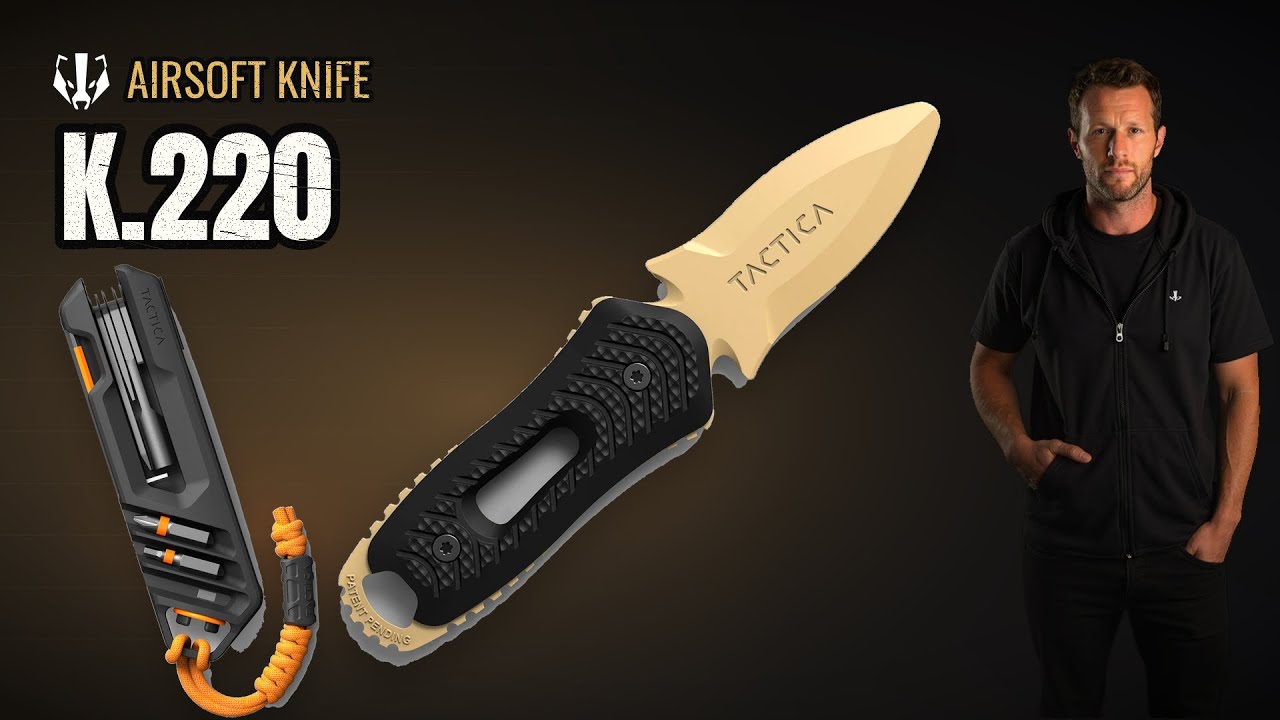
Then I actually pulled one out of its packaging and realized what they’d sent: the airsoft version. Tactica has a full airsoft category on their site, and the K.220 airsoft knife is a $25 plastic training blade, not the £70 real one. Which, for this channel, is exactly the right product. They clearly knew who they were sending it to.
K.220 Airsoft Knife — The Twist-Lock Is the Whole Story
The knife itself is a rigid, dulled plastic blade — rounded off at the tip, no edge, not going to hurt anyone. It has a serrated texture on the grip, a lanyard point, and a cut-out through the middle of the blade. The first thing you notice is the weight, or the lack of it. This thing weighs next to nothing.
The retention system is the clever part. You cannot pull this knife straight out of the holster — it’s physically impossible, and I tried on camera. You twist it toward yourself and it releases. Twist it the other way and nothing happens. That means it won’t shake loose or get snagged out during a game, but the draw is still a genuine one-handed operation: twist, pull, done. No second hand needed to defeat a retention strap.
The holster is solid polymer and mounts to MOLLE — plate carrier, battle belt, wherever you’ve got webbing. It threads through two MOLLE cutouts, and there’s a clip on the back with a screw-down fastener so once it’s on, it’s locked in place rather than just friction-fit. If you want it to sit closer to your kit, you can remove one bolt, take the back clip off entirely, and the holster mounts flush. I threaded it onto laser-cut MOLLE in the video and it sits absolutely rock solid.
They sent me two — tan and red — and the site lists blue and black as well. The tan will disappear into my loadout nicely, and it’s the one I’ll run on my plate carrier. But there’s a real argument for the red: it reads instantly as a training blade. I’ve run a bright blue trainer on other kit for the same reason. Nobody at the field should ever have a half-second of doubt about what they’re looking at, and the red one removes that doubt completely.
Where a Training Blade Actually Fits in a Game
For anyone new to this: a lot of fields allow knife kills as an honor melee. You’re not slashing anyone — you close the distance in a tight CQB corner and tap them. Some fields run a bang-bang rule instead, and some don’t allow melee at all, so check before you run one. There’s also a field-rule caveat specific to this knife: some sites only allow rubber blades that bend a full 180 degrees. The K.220 airsoft version is rigid plastic. It won’t fold over. If your field has that rule, this doesn’t pass it — check first.
The culture around knife kills is part of why I love them. I was at HC2 and the pre-game briefing literally included an instruction: if someone gets you with a knife kill, give them a fist bump, because it’s a harder kill to earn than any shot from distance. A dedicated, properly retained trainer makes that moment possible without any of the risk of a real blade. For $25, with a holster that actually locks the knife in — which is genuinely rare for rubber and plastic trainers — this is a very good option.
Sidekick Field Multi-Tool — Built for Airsoft, Not Adapted to It
The second product in the box is the one I keep thinking about. The Sidekick Field Multi-Tool is $50, and it’s the rarest thing in this hobby: a tool designed specifically for airsoft, from the ground up. Most of what we carry is real-steel gear that happens to work for us. The instructions for this thing reference AEGs by name.
The problem it solves is one I live with. Right now, my field kit is an Allen key and a tiny flathead screwdriver, carried loose, so I can adjust my optic or my hop-up mid-game without walking back to the safe zone. The Sidekick replaces that with one tool that fits in an airsoft pistol mag pouch — I’d run mine in a general-purpose pouch or a dangler — and weighs 4.9 ounces, 140 grams.
The layout: four attachment heads stored in the body on magnetic mounts, plus two spare magnetic slots left empty so you can add whatever bits your specific airsoft replica needs. Everyone’s kit is different, and they clearly understood that. There’s a hex key on board with room to magnetically carry a second one — useful if your hop-up wants a thinner key than the one it ships with, or for something like the grub screw on a flash hider. An extension bar gives you reach, and it’s long enough to get down into a stock tube. The bit head can also be turned sideways so the whole tool becomes a T-handle, which gives you real torque on a tight screw instead of fingertip-twizzling.
The airsoft-specific bits are what sold me. One of the heads is purpose-made for an AEG grip screw — the motor screw. Another is a battery cap tool for opening and closing battery compartments. There are Allen keys, flathead and wedge pieces, and screw heads. And the detail that made me laugh when I worked it out on camera: the little orange ring on the top is a spare O-ring holder. You can carry replacement O-rings clipped onto the tool itself. They thought about what actually breaks and loosens during a game day.
It ships with an orange paracord lanyard. My first instinct was to swap it for something in a tactical color, but I’ve talked myself out of it — orange means you can find the thing at the bottom of a kit bag, and that matters more than looking the part.
Verdict
I’m a fan, and I don’t say that because the box was free. The K.220 airsoft knife at $25 solves trainer retention properly — the twist-lock draw is the best I’ve handled on a plastic blade — and the Sidekick at $50 is a genuinely airsoft-native multitool at a fair price. Both are going in my kit.
Two follow-ups from here. First, I’m buying one of their real K.220 blades myself, partly because the design got its hooks into me and partly to test a theory: if the real knife fits the same holster, I can swap blades between MilSim and regular airsoft use and keep one mount on my plate carrier. Obviously the real blade never comes to an airsoft game — that rule from the top of this post doesn’t move. Second, I’ll be running both of these in actual games and putting out shorts so you can see how they hold up.
Thanks to Tactica Gear for sending the box over. Questions on either product, drop them in the comments on the video.