
DNT Optics NVMD-C200 Review: An $800 Optic That Does Daytime, Night Vision, and Scope Cam in One Package
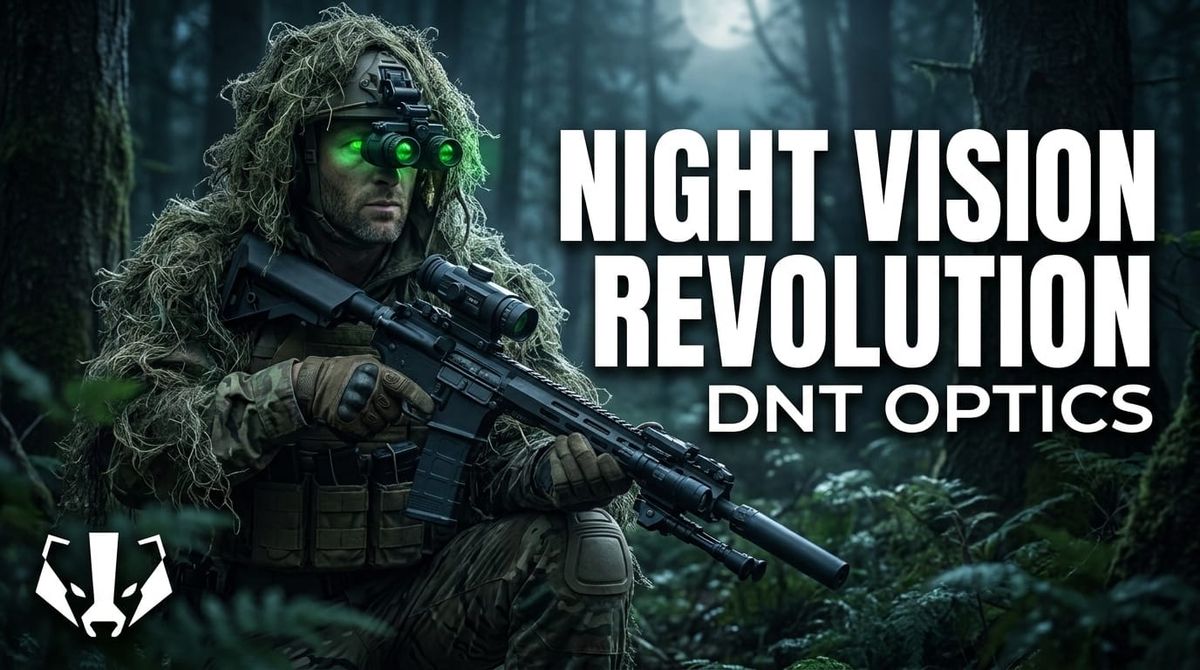
DNT Optics NVMD-C200 Review: An $800 Optic That Does Daytime, Night Vision, and Scope Cam in One Package
Night vision in airsoft has always been a pay-to-play proposition. A decent set of nods runs you three to four thousand dollars before you even think about mounting solutions, sacrificial lenses, or the IR illuminator you’ll need when the moon isn’t cooperating. The DNT Optics NVMD-C200 takes a different approach: instead of hanging tubes in front of your eyes, it puts a digital night vision sensor behind a daylight-capable optic and calls it a day. At $800, it’s either the best value in airsoft optics or a compromise that tries to do too much. After fielding it at Fontana Ranch for a full day-and-night event, Ed’s verdict is in.
What the NVMD-C200 Actually Is
The NVMD-C200 is a digital optic — think of it as a small screen inside a scope body rather than a traditional glass-and-reticle arrangement. That screen is the secret to everything this unit does. In daytime mode, it functions as a magnified optic with digital zoom. Flip it to night mode, and the sensor switches to infrared sensitivity with your choice of green phosphor or white phosphor rendering. It also records everything you see through the optic to internal storage, complete with a HUD overlay showing time, battery level, zoom multiplier, Bluetooth connection status, microphone status, and — this is the clever bit — a digital level indicator so you can tell whether your platform is canted before you send a BB downrange at 50 meters.
DNT Optics sent the unit to Ed for review. The company wasn’t on his radar before they reached out, which is worth noting — this isn’t a Vortex or a Holosun with a decade of brand equity behind it. It’s a newer player making an ambitious product at an aggressive price.
Daytime Performance: Scope Cam Built In
Ed ran the NVMD-C200 as his primary optic for the daytime portion of the Fontana Ranch event, ditching the LPVO he’d originally planned to mount. The digital zoom — controlled by a rotary adjustment on the unit — was faster to manipulate than twisting an LPVO ring, and the screen remained visible even in California afternoon sun.
The recording feature captures circular scope-cam footage with the full HUD overlay. You can strip the reticle and some of the data from the recording if you want cleaner footage, but the circular frame is baked in — this is scope-cam output, not a flat wide-angle action cam. For YouTubers who currently run a separate scope cam rig, having recording built into the optic eliminates a mounting headache and a second battery to manage.
The level indicator deserves a specific callout. When you’re taking ranged shots with a hop-up that applies backspin, cant in your platform sends the BB curving off-axis. A digital level in the sight picture means you catch the cant before the shot, not after you watch the BB sail wide.
Night Vision: The Main Event
This is where the NVMD-C200 separates itself from every other optic in its price bracket. At night, the sensor switches to infrared-sensitive mode. Ed ran it on his WellPro WD-23 — a compact platform — using the optic as his primary night vision device rather than his traditional nods setup.
The unit offers both green phosphor and white phosphor rendering. A firmware update released between Ed’s unboxing video and this field test improved the night vision quality further; the footage in the video was captured on the pre-update firmware, so current production units should perform better than what’s shown.
The practical advantage of a platform-mounted night vision optic over helmet-mounted nods is situational awareness trade-off versus aiming precision. With traditional nods, you can scan independently of where your platform is pointed, but actually aiming through an optic at night requires either an IR laser (visible to anyone else with night vision) or passive aiming through a night-vision-compatible red dot. The NVMD-C200 collapses that problem: what you see through the optic is your night vision sight picture, and you can record it.
Ed noted that players at the event who weren’t running any night vision were at a significant disadvantage once the sun went down — especially on a low-moonlight night. A unit like this wouldn’t fully close the gap against a player with Gen 3 white phosphor tubes and an IR laser, but it would give them a fighting chance for a fraction of the cost.
Battery and Practical Concerns
Battery life held up through the event. Ed never saw the indicator drop below 50%, though he topped up from a power bank during safe-zone returns as a precaution. The unit has a swappable battery — he carried a spare but never needed it. The charging port is accessible while mounted, so running a cable to a power bank in a backpack is viable for extended operations.
The internal storage is the one hardware limitation Ed flagged. There’s no external SD card slot — footage saves to built-in memory, and you pull it off via USB when you get home. He didn’t fill the storage during the event, but a one-terabyte SD card would be a more flexible solution for players who want to record entire game days without a laptop in the staging area.
Durability is an open question. DNT Optics told Ed they haven’t tested the unit against direct BB impacts. A lens protector or kill-flash is strongly recommended — Ed didn’t run one and got lucky, but he’s not recommending anyone else roll those dice on an $800 optic.
The Value Math
Here’s the comparison that makes the NVMD-C200 interesting:
- Traditional night vision (binocular nods): $3,500+
- Scope cam setup (separate camera + mount): $200–$400
- Quality LPVO or magnified optic: $300–$800
- IR laser for passive aiming under nods: $200–$500
The NVMD-C200 does all four functions for $800. It’s not best-in-class at any single one — a dedicated Gen 3 white phosphor tube will outperform the digital night vision sensor, and a purpose-built action camera will give you cleaner wide-angle footage. But for a player who wants night vision capability, scope-cam recording, and a daylight-usable magnified optic without spending five grand and managing three separate battery systems, the value proposition is hard to argue with.
Who This Is For
The NVMD-C200 makes the most sense for three types of airsoft players:
- The milsim player on a budget who wants night vision capability but can’t justify $3,500 for traditional nods — especially if they only play one or two night events per year.
- The content creator who currently runs a separate scope cam and wants to eliminate a mounting point, a battery, and a post-processing sync step from their workflow.
- The tech-curious player who likes having one device that does multiple jobs, even if none of them are reference-class.
It’s probably not the right choice for the player who already owns Gen 3 white phosphor tubes and an IR laser — you’ve already solved the night vision problem, and the NVMD-C200 would be a sidegrade at best. It’s also not ideal for someone who needs wide-angle recording for cinematic gameplay footage; the circular scope-cam format is specific, not general-purpose.
Bottom Line
Ed’s verdict after a full day-and-night event: “Two thumbs up. For the price, it’s great.” The NVMD-C200 delivered reliable daytime performance, usable night vision, and scope-cam recording without a single failure across six hours of gameplay. The firmware update path suggests DNT Optics is actively improving the product rather than shipping and forgetting it.
At $800, it’s not cheap. But compared to the four-figure sum you’d spend assembling equivalent capability from separate components, it’s the most efficient path to night vision in airsoft right now.
Watch the full review: I Fielded the DNT Optics NVMD-C200 — It’s More Than Just an Optic
Product provided by DNT Optics for review. This post contains no affiliate links. Source transcript: processing/my_first_gameplay_experience_with_the_dnt_optics_nvmd-c200/transcript/transcript.txt. Gear DB: brain/09-gear/DNT Optics.md.