
Everything I've 3D Printed for Airsoft in My First 12 Months — The Good, The Bad, and The Ugly
After a full year with my Bambu Lab H2D, I dumped out the box of everything I've printed for airsoft. Rails, suppressors, grips, mag covers, camera mounts — here's what worked, what didn't, and why you should buy a 3D printer tomorrow.
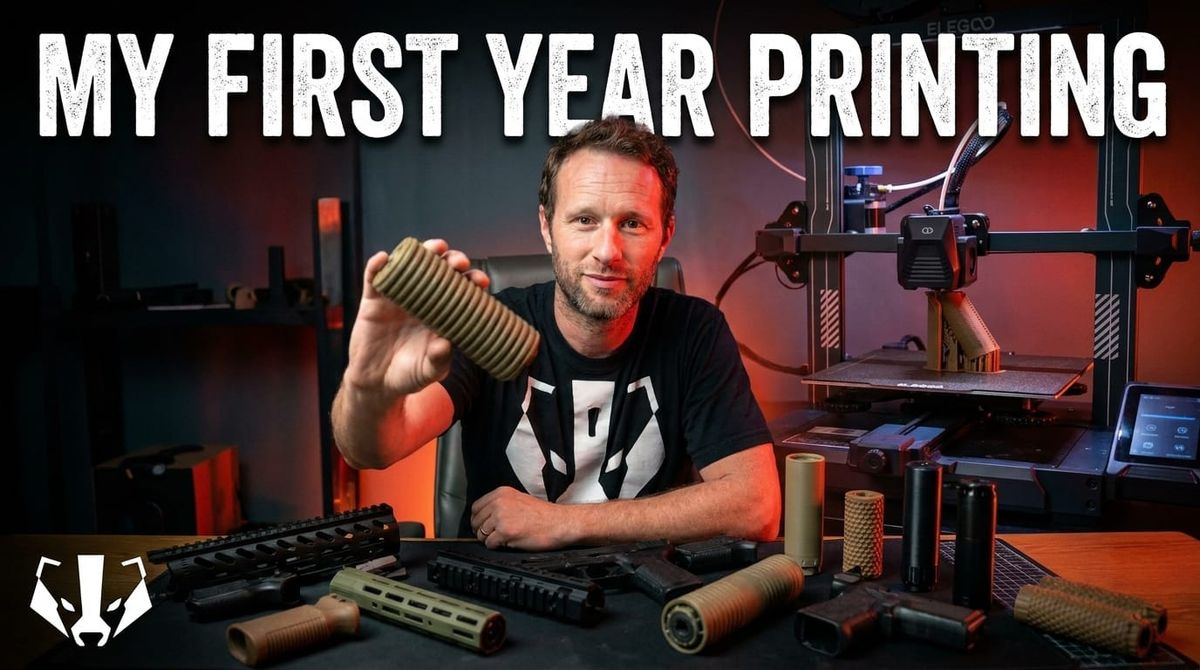
Everything I’ve 3D Printed for Airsoft in My First 12 Months — The Good, The Bad, and The Ugly
About a year ago, I made a video called “Things I 3D Printed in the First Two Weeks of Having a 3D Printer for Airsoft.” I didn’t think much of it at the time, but I checked the numbers recently and that video crushed it — one of the most successful on the channel, and I didn’t even realize it.
Well, it has now been over 12 months. I have printed a lot more stuff. Some of it is amazing. Some of it is sitting in a box waiting to be given away to channel members. And some of it taught me things about filaments, infill, and design that I wish I had known on day one.
So I dumped out the box. Here is everything I have printed for airsoft in my first year — what worked, what didn’t, and what I would tell anyone on the fence about buying a 3D printer.
The Printer: Bambu Lab H2D
Before anyone asks: I run a Bambu Lab H2D. It is on the higher end. You do not need to spend this much. Bambu Lab makes cheaper models, and there are plenty of other brands that will do nearly the same thing — maybe not quite as conveniently, but close. If you have the space and the budget, just get one. Even if you are not deep into 3D printing as a hobby, being able to go online, find a file, download it, and print something useful the same afternoon is genuinely fun.
Rails and Handguards: Fixing the Guns That Need It Most
The Sega 12 SBS is a gun I have talked about before, and I will say it again: I hate the way it looks out of the box. The stock rail situation is bad. Your options are basically one aftermarket rail you can buy, or you get a 3D printer and fix it yourself.
I printed the Zeus Rail from Blacktorch Industries — they released the file and I grabbed it. The first print I did had a rough finish. That happens. You can sand it down, rub it down, spray it, and it would look great. I ended up not using that particular one, but the file itself is solid. I also printed a Bastard Labs rail and gas tube upper for the Sega 12 SBS, and that one came out really comfortable. The color wasn’t perfect — I should sand and spray it — but functionally it transformed the gun.
For my G36C, I printed a full rail. That thing works amazing. My G36C previously had no M-LOK, which meant I was constantly trying to figure out how to mount a light or a laser. Now I have a foregrip on there, mounting options everywhere, and it completely changed how I run that replica. That single print might be the highest-value thing I have done.
Filaments: What I Actually Use
This is the part I wish someone had explained to me clearly on day one. Here is the breakdown:
PLA Plus / PLA Pro — This is my workhorse. eSun PLA Plus and Polymaker PLA Pro are the two I reach for most. About $19 per kilogram roll. You can print 20 to 30 pistol grips from a single roll. It prints fast, it does not require an enclosed printer, and the finish is good. Not great — you will see some shine — but sand it and it looks fantastic.
ABS GF (Glass Fiber) — This is the premium option. About $35 per roll, almost double the cost of PLA Plus. It requires an enclosed printer because the heat bed and chamber need to get hot. The upside: it is more hard-wearing, better in UV light, and the finish is noticeably better. I printed a Die Freco-style pistol grip in this, and the surface quality is genuinely impressive. If you are printing something that is going to take abuse or sit in direct sunlight, this is the move.
What I would not use: Standard PLA. The basic stuff — like the Bambu Lab PLA that comes with the printer — will warp in heat. Leave it in a car on a warm day and it is done. Skip it for anything airsoft-related.
Suppressors: The Category Where 3D Printing Wins Hard
I have printed more suppressors than anything else, and this is where the economics get absurd. A real Manta suppressor cover — the full-length one — is about $80. You cut it down to size. What I did instead: I printed a lightweight Socom-style suppressor body in polymer, then put the real Manta cover over it. The 3D-printed core weighs almost nothing, costs less than a dollar in filament, and the cover gives it the look and feel I want. That hybrid approach — printed core, real-steel cover — works incredibly well.
The MCQ Night’s Armament suppressor is another one I have printed multiple times. This takes an Acetech Brighter C tracer unit inside. The original design had a plastic retaining coil that GBB recoil would pop out of place. I gave that feedback to the designer and he redesigned it with a threaded insert and a tightening tool. Now it runs on 40mm clockwise threads and is rock solid. I printed one in tan, one in black. Once you buy the file for a few dollars, you can print as many as you want.
I have also printed shotgun suppressors for the Acetech Quark C/M and a range of other styles. When each one costs less than a dollar, you can experiment without committing to an $80 purchase and hoping it looks right.
One thing I learned: do a test print first with low infill to check fit. Once you know it works, reprint at 100 percent infill. It takes longer and uses more filament, but it will not crack if a BB hits it.
Grips: Print Them All, Keep the Ones That Fit
I have printed more grips than I can count — vertical, angled, reverse-angle, K2 Plus style, Die Freco copies. Some I loved. Some I held for five seconds and threw in the giveaway box. That is the point. Each one costs less than a dollar. You are not gambling $40 on a grip that might not fit your hand.
I have also started running heat-set threaded inserts in grips and rails — a cheap heat gun attachment on Amazon, push the brass insert into the print, and now you have real metal threads. It sounds intimidating. It is not.
The Weird Stuff That Turned Out Great
The Lancer Mag covers for my XM7 magazines are something people constantly ask me to print. They slide over standard mags and make them look like L7 Lancers. You cannot buy these as an aftermarket part — they simply do not exist. But the file exists, and now I have them.
The AP01 lower that takes MP5 magazines is another one. Print the lower, slap an AP01 upper on, and now you are running MP5 mags in a pistol platform — HPA or green gas. That kind of cross-compatibility would cost serious money in injection-molded parts.
Camera mounts for Picatinny rails, GoPro brackets, scope-cam arms — if you need a specific mounting solution for a specific angle on a specific gun, you can probably find the file. And the BB unloader for GBB magazines is a free file I found. You put it on top of a magazine and it unloads the BBs. Simple, clever, costs nothing.
What I Would Tell Someone on the Fence
Buy the printer. If you have the space and can afford even an entry-level Bambu Lab or equivalent, just do it. I use mine constantly — it is rare that it is not printing something. I print things for friends. I printed an ammo puck for a friend’s new real-steel pistol that holds nine-millimeter rounds for range days. Costs almost nothing, makes a great gift.
The files are everywhere. Bambu Marketplace has tons of free uploads. Sites like Cults 3D charge a few dollars per file, and once you buy it, it is yours. Print as many as you want for yourself and your friends.
Where This Is Going: AI and 3D Printing
I have started experimenting with AI-generated 3D models. Our phones have LiDAR now — you can scan an object and generate a printable file. I have already used my AI agents to design simple things like the A and B signs for my “pick one” shorts. I described what I wanted, the AI generated the STL, and I printed it in two colors.
I think in a couple of years, you will scan a part with your phone, tell an AI to extract the dimensions and generate a print file, and have it ready that afternoon. We are not there yet, but we are closer than most people realize.
For now, the printer on my desk has already paid for itself in grips I did not buy, suppressors I did not order, and rails that simply do not exist as commercial products. If you have been on the fence, this is me pushing you off it.